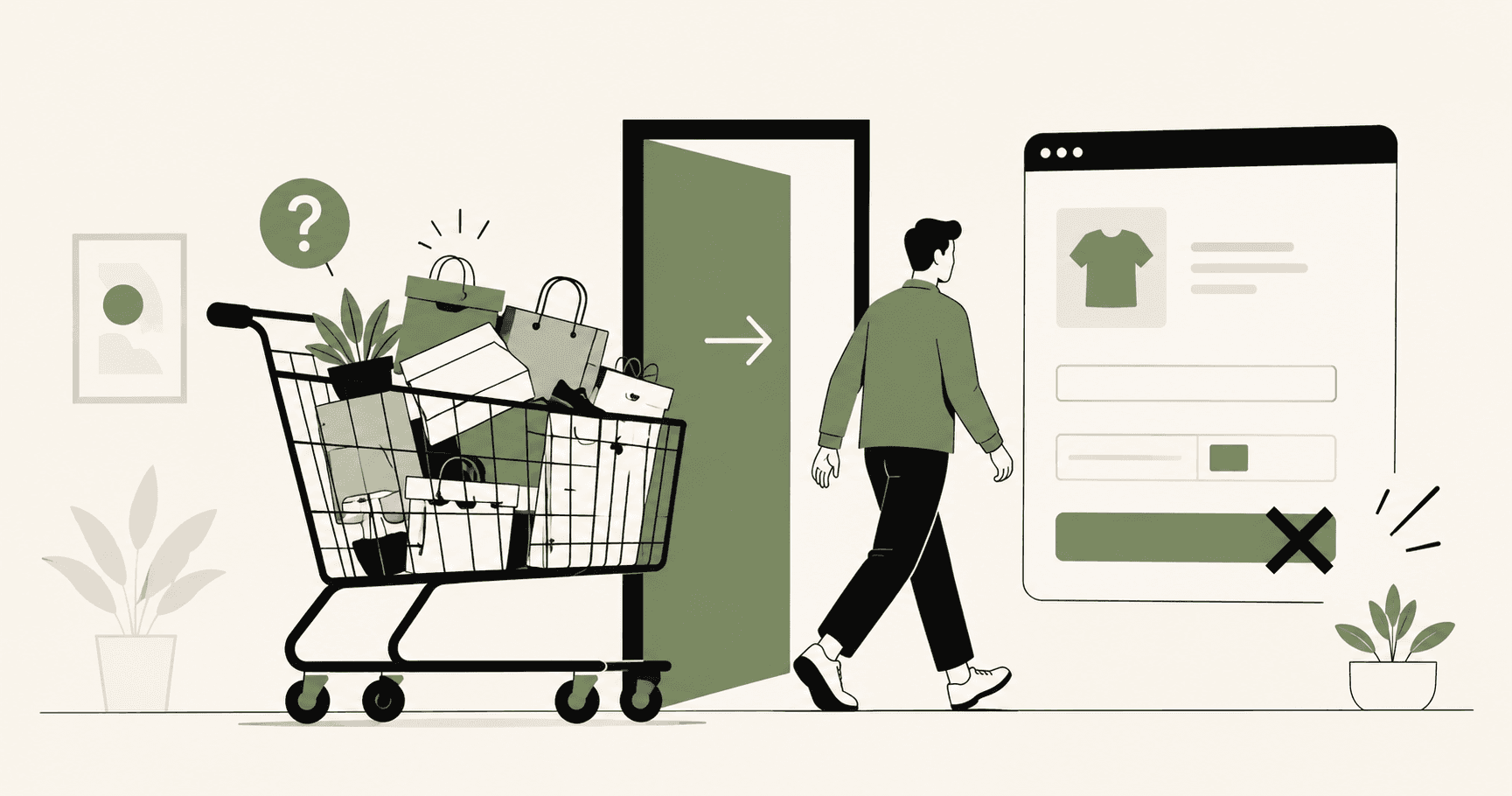
You have add-to-carts. You have traffic. You have zero sales.
So you go looking for answers, and the internet hands you the same list every time: add trust badges, collect more reviews, lower your prices, install a countdown timer. Maybe throw in a pop-up discount for good measure.
Most of that advice is wrong. Not useless — wrong. It addresses the symptoms people assume you have, not the problem you actually have.
Here's the thing about add-to-cart behaviour: it's one of the strongest signals of purchase intent you can get. Someone found your product, looked at it, decided they wanted it, and put it in their cart. That's not a traffic problem. That's not a trust problem. That person trusted you enough to start the purchase process.
Something happened between the cart and the confirmation email. And almost every time, it's one of the same four or five things — none of which are fixed by adding a star rating widget.
The number first, because it reframes everything
70.22%. That's the average cart abandonment rate in 2026, according to Baymard Institute's meta-analysis of 50 separate studies. Seven out of every ten people who add something to a cart don't buy.
If your store is abandoning at, say, 75%, you're not catastrophically broken. You're slightly above an already-terrible industry average. The question isn't whether people abandon — they always do. The question is why yours abandon at the rate they do, and whether that rate is fixable.
Baymard estimates that $260 billion in lost orders are recoverable through better checkout design alone. Not better products. Not better prices. Better checkout design.
That number should make you angry, because it means most abandonment isn't customer indifference — it's friction you created.
The real reasons people leave (and it's not your prices)
1. You ambushed them with the actual cost
This is the single biggest driver of abandonment, and it's been the single biggest driver for years. Baymard's research puts it at 48% of all abandonments: the shopper reaches checkout, sees the real total with shipping and taxes added, and leaves.
They weren't unwilling to pay for the product. They were unwilling to pay a price that was different from the one they agreed to when they added it to the cart.
The psychological mechanism here matters. It's not sticker shock — it's betrayal shock. You showed them £29.99. The checkout says £41.47. Even if £41.47 is completely reasonable, the gap between expectation and reality triggers an exit.
The fix is not to offer free shipping (though that helps). The fix is to show the full cost earlier. Put estimated shipping on the product page. Show the tax-inclusive price if your market expects it. Kill the surprise.
2. You're making them jump through hoops to give you money
One in five shoppers abandons because the checkout process is too long or too complicated. Read that again.
They want to buy. They're trying to buy. And you've built a checkout that makes buying feel like a chore.
The most common offenders:
Forced account creation. Requiring someone to register before they can purchase is one of the most reliably conversion-killing decisions a store owner can make. Guest checkout isn't a nice-to-have. It's table stakes. If your Shopify store still requires an account at checkout, fix that today — it's a single toggle in your settings.
Too many form fields. Every additional field you ask someone to fill in is an opportunity for them to stop. Do you need their phone number? Their date of birth? Their company name? Probably not. Every field that isn't strictly necessary to ship the order is a field you should remove.
Confusing multi-step flows. Shopify's one-page checkout exists for a reason. If you've customised your checkout and made it more complicated in the process, you've likely cost yourself sales you'll never be able to trace back to that decision.
3. Your mobile checkout is a disaster
Mobile abandonment sits at over 80% compared to 66% on desktop. That gap isn't because mobile shoppers are less committed — it's because mobile checkout experiences are consistently worse.
Think about what your checkout actually looks like on a phone. Small tap targets. Keyboards that obscure form fields. Payment forms that don't trigger the right keyboard type. Images that don't load. Buttons that are technically present but feel unresponsive.
Here's a test worth doing right now: go through your entire checkout on your actual phone, not a browser emulator, and time how long it takes. If it takes you — someone who knows your store, knows what you're selling, is motivated to finish — more than two minutes, it takes a first-time mobile customer considerably longer.
One-tap payment options like Apple Pay, Google Pay, and Shop Pay are the single most effective mobile checkout fix available. Stores that make these prominent see meaningfully lower mobile abandonment, because they eliminate the form entirely for a large portion of buyers.
4. Something is broken and you don't know about it
This one is uncomfortable, but it needs to be said: a significant portion of Shopify add-to-cart abandonment isn't a decision. It's a failure.
A button that doesn't work on a specific browser. A payment step that errors out silently. A page that times out on a slow connection. A form field that won't accept valid input. A discount code that applies to the cart but then disappears at checkout.
Shopify community forums are full of store owners who spent weeks convinced their conversion rate problem was a trust or price issue, only to discover their checkout had been broken on Android Chrome for two months.
If you're seeing high add-to-cart and almost no completions, rule out a technical failure before you change anything else. Go through your checkout on multiple devices, multiple browsers, and check your Shopify error logs. This sounds obvious. Most people don't do it.
5. You're losing them in a specific place, and you're not looking
Most store owners know their overall cart abandonment rate. Almost none of them know where in the checkout flow people actually leave.
Is it on the cart page itself, before they even reach checkout? Is it at the shipping address step? Is it when they see the order summary with shipping added? Is it at the payment step?
These are completely different problems with completely different fixes. Losing people on the cart page suggests the problem is earlier in the funnel — product page or price presentation. Losing people at the payment step suggests a trust issue or a payment method mismatch. Losing people right after shipping is added confirms the hidden cost problem.
Tools like Wahilens track exactly where in this flow people drop off, ranked by how much that drop-off is likely costing you. Instead of guessing which step to fix first, you see: this many people abandoned here, and here's what it's probably worth to fix it. That changes the conversation from "why aren't people buying?" to "this specific step is broken and fixing it is worth approximately this much per month."
What the standard advice gets wrong
The go-to advice — more reviews, more trust badges, lower prices — isn't bad advice in isolation. Social proof matters. Price competitiveness matters.
But here's the problem with leading with those fixes: they're designed to address pre-purchase hesitation. They're for someone who's browsing your store and hasn't committed yet.
The people in your abandoned carts already committed. They added the item. They started checkout. The hesitation came later, and it almost always came from something concrete: a surprise cost, a broken flow, a payment step they didn't trust, a form that was too much work on a phone.
Fixing your checkout friction is less visible than redesigning your homepage. You don't get the same satisfaction from removing a required form field that you get from publishing a fresh batch of product photos. But the returns are disproportionately large because checkout is where the money actually moves.
A realistic picture of what's worth fixing first
Not all abandonment is equal, and not all fixes cost the same to implement.
| Problem | Effort to fix | Revenue impact |
|---|---|---|
| Forced account creation | Low (settings toggle) | High |
| Hidden shipping costs | Low (show earlier) | Very high |
| No one-tap payment (Apple/Google Pay) | Low (enable in settings) | High on mobile |
| Too many form fields | Medium | Medium–high |
| Checkout broken on specific device/browser | Medium (requires testing) | Unknown until found |
| General checkout flow length | Medium–high | Medium |
Start with the top three. They take less than an afternoon to implement and they address the causes that Baymard's research identifies as driving nearly half of all abandonment.
What to actually do now
Step one: Go through your checkout right now on your phone. Time it. Screenshot every step.
Step two: Check whether guest checkout is enabled. If it isn't, enable it. This is the fastest single fix available to you.
Step three: Look at where shipping costs appear in your flow. If the first time a customer sees the full total is at the checkout summary step, that's your primary problem. Add shipping estimates to the product page or cart page.
Step four: Enable Apple Pay and Google Pay if you haven't. This is one toggle in Shopify Payments settings and it removes the form entirely for a large portion of mobile buyers.
Step five: Find out where specifically people are leaving. Not your overall abandonment rate — the exact step. Until you know that, you're guessing about what to fix. And guessing is expensive.
The add-to-carts aren't the problem. They're evidence that your product is fine and your targeting is working. The problem is between the cart and the confirmation. That problem is almost always fixable — if you know where to look.
If you're losing customers at the same rate, there's also a broader look at why Shopify stores lose customers worth reading alongside this. And if checkout is converting but your landing pages aren't, that's a separate diagnosis entirely.
See it in action
Know exactly where your visitors drop off.
One script tag. No credit card. Your first report in under a week.
Start free trial