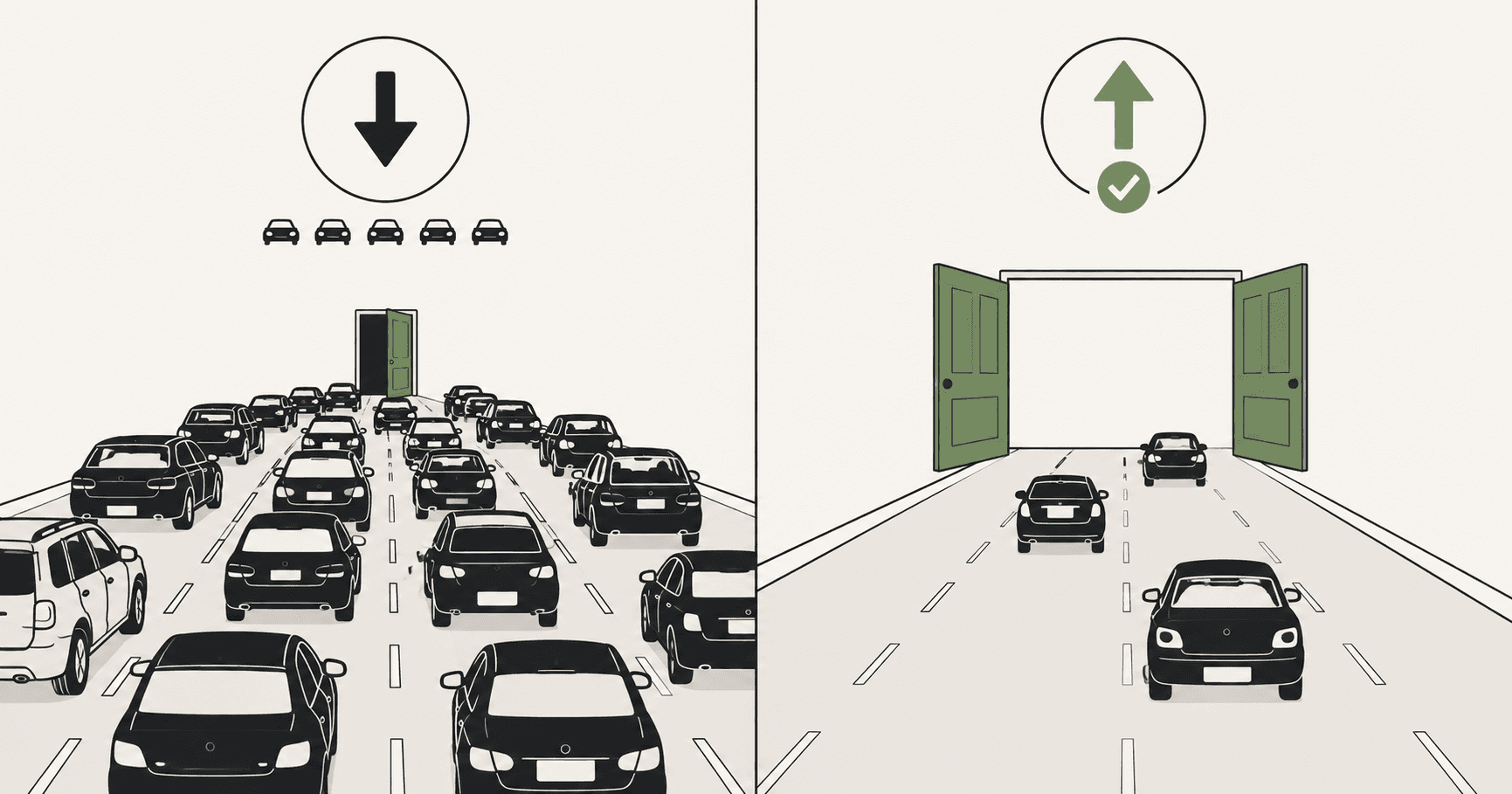
Everyone wants more traffic.
More visitors, more clicks, more eyeballs. It's the default growth strategy for almost every business with a website — spend more on ads, post more content, chase more followers.
And traffic matters. You can't convert visitors you don't have.
But here's what most people get wrong: traffic is only half the equation. The other half — the half most businesses almost completely ignore — is what happens after the visitor arrives.
That's what conversion rate optimisation is. And once you understand it properly, you'll never think about website growth the same way again.
The simplest possible definition
Your conversion rate is the percentage of visitors who do what you want them to do.
If 1,000 people visit your website and 20 of them sign up, buy something, or book a call — your conversion rate is 2%.
Conversion rate optimisation (CRO) is the process of increasing that percentage. Finding out why the other 980 people left without converting, and systematically removing those reasons one by one.
That's it. No complicated framework. No agency jargon. Just: more of the people who already visit your site doing the thing you want them to do.
Why traffic obsession is backwards
Here's a thought experiment.
You have a shop on a busy high street. A hundred people walk past every hour. Five of them come in. Of those five, one buys something.
Your conversion rate — from passerby to customer — is 1%.
Most business owners in this situation would say: "I need more foot traffic." And so they spend money on advertising, on a bigger sign, on a better location.
But a smarter question is: why are 99 out of 100 people walking straight past? And of the 5 who come in, why are 4 of them leaving without buying?
Fix those two things — and you've multiplied your revenue without spending a penny more on getting people through the door.
This is the core insight behind CRO. You already have traffic. That traffic costs you money — in ads, in content, in SEO effort, in time. Every visitor who leaves without converting is money you've already spent that produced no return.
More traffic into a leaking store just means more leaking.
The maths that make CRO so powerful
Let's make this concrete.
Say your site gets 5,000 visitors a month. Your current conversion rate is 1.5%. That means 75 conversions — sales, signups, leads, whatever your goal is.
Scenario A: You double your traffic. You spend significantly more on ads. Now you have 10,000 visitors a month. At the same 1.5% conversion rate, you get 150 conversions. Revenue doubles. So does your ad spend.
Scenario B: You double your conversion rate. You don't spend a penny more on traffic. You fix the things that are making people leave. Now you have the same 5,000 visitors a month, but at a 3% conversion rate — 150 conversions. Revenue doubles. Ad spend stays exactly the same.
The outcome is identical. The cost is completely different.
And here's where it gets even better: these two scenarios compound. If you double your traffic and double your conversion rate, you don't get 2x the results. You get 4x. CRO multiplies the return on every other marketing investment you make. Better conversion rate means every pound you spend on ads works harder. Every blog post you write converts more readers. Every email you send produces more action.
This is why the best marketing teams in the world treat conversion rate as a core metric — not a nice-to-have.
What CRO actually looks like in practice
CRO sounds abstract until you see what it means on a real website.
Here are some examples of what conversion rate optimisation actually involves:
A SaaS company notices that visitors who reach their pricing page convert at 8%, but only 40% of visitors actually make it to the pricing page. The CRO opportunity isn't on the pricing page — it's in whatever is stopping 60% of visitors from getting there in the first place. They look at the navigation, the homepage copy, the calls to action. They find that their main CTA says "Learn More" — which signals more reading, not action. They change it to "See Pricing." Pricing page visits increase by 30%. Revenue follows.
An ecommerce store has a 2% conversion rate overall, but when they break it down by device, mobile converts at 0.8% and desktop converts at 4.1%. The site works fine on desktop. On mobile, the checkout form has 11 fields, the images load slowly, and the Add to Cart button is below the fold. Fixing mobile checkout alone moves overall conversion from 2% to 2.9%. That's a 45% revenue increase from one fix.
A service business gets 200 enquiries a month through their contact form, but only 15% of those turn into booked calls. They look at what happens after the form is submitted. The confirmation page just says "Thanks, we'll be in touch." There's no expectation setting, no indication of next steps, no reason to feel confident the right person will call. They add a confirmation email, a calendar link, and a short video from the founder. Booking rate goes from 15% to 34%.
None of these required more traffic. All of them required understanding why visitors weren't converting — and then fixing it.
The most common CRO mistakes beginners make
If you're new to CRO, there are a few mistakes that waste enormous amounts of time and money.
Guessing instead of measuring
The most common CRO mistake is skipping the diagnosis and going straight to the solution. "Our conversion rate is low, so we'll redesign the homepage." Maybe. Or maybe the homepage is fine and the problem is the checkout. Or the pricing page. Or the mobile experience.
Without measuring where visitors are dropping off, you're guessing — and redesigning the wrong thing. A full site redesign is expensive, time-consuming, and often makes no difference to conversion because the redesign fixed a problem that wasn't actually the main problem.
Measure first. Fix second. Always.
Running tests too short
A/B testing — showing different versions of a page to different visitors and measuring which converts better — is the most reliable CRO tool there is. But it only works if you run tests long enough to get statistically meaningful results.
Most beginners run a test for three or four days, see a variation performing better, and call it a win. But with small sample sizes, random variation can look like a real result. A test that runs for less than two weeks, or that doesn't have at least a few hundred conversions per variation, is almost meaningless.
Patience in testing isn't optional. It's what separates real insights from noise.
Optimising the wrong metric
Conversion rate is the headline metric, but it's possible to increase it while actually hurting your business.
A dramatic discount increases conversion rate. So does removing friction from a free trial signup — but if the people who sign up are lower quality leads who never convert to paid, you've optimised yourself backwards.
Always connect your CRO metric to a business outcome. For ecommerce, that's revenue per visitor, not just orders. For SaaS, it's trial-to-paid conversion, not just trial signups. For service businesses, it's booked calls from qualified leads, not just form submissions.
Making too many changes at once
If you change your headline, your hero image, your CTA button colour, and your pricing structure all at the same time — and conversion goes up — you have no idea which change caused it. And if conversion goes down, you have no idea what to undo.
CRO is a process of controlled experiments. Change one thing. Measure the result. Keep or revert. Then change the next thing. It's slower than a big redesign, but every insight is real and repeatable.
How to start — what to measure first
If you've never done CRO before, here's where to begin.
Step 1: Know your current conversion rate. Pick one conversion goal — a purchase, a signup, a form submission, a booking. Divide the number of conversions last month by the number of visitors last month. That's your baseline. Write it down. You can't improve what you haven't measured.
Step 2: Find your biggest drop-off point. Your website is a funnel. Visitors enter at the top and either convert or leave at various points along the way. Your job is to find where the biggest leak is.
Look at your analytics. Where are people landing? Which pages have the highest exit rates? If you have a multi-step process — like a checkout or a signup flow — where do people abandon? The page with the biggest drop-off is where you start.
Step 3: Understand why people are leaving. Page views and exit rates tell you where people leave. They don't tell you why. For that, you need behavioural data — what people actually do on the page before they leave.
Are they clicking something that doesn't work? Are they dropping off at a specific form field? Are they leaving immediately, before they've had a chance to read anything? Are they on mobile with a broken layout?
Tools like Wahilens track this automatically — every rage click, every dead click, every form drop-off — and translate it into plain-English findings ranked by revenue impact. Instead of hours in a dashboard, you get: "Visitors from mobile leave your pricing page in under 8 seconds. Estimated impact: ~$1,100/month." That's a starting point, not a data set to interpret.
Step 4: Form a hypothesis and test it. Based on what you've found, form a specific hypothesis. Not "the homepage needs to be better" but "changing the CTA from 'Learn More' to 'See how it works' will increase clicks to the product page because the current CTA implies more reading, not progress."
Specific hypothesis. One change. Measured result. That's a CRO experiment.
Step 5: Implement the winner and move to the next. If the test wins, keep the change and move to the next biggest drop-off point. If it loses, revert and form a new hypothesis. Either way, you've learned something real about your visitors — and that knowledge compounds over time.
When CRO matters most — and when it doesn't yet
CRO isn't for every stage of a business.
If your site gets fewer than 500 visitors a month, CRO should not be your priority. You don't have enough traffic to run meaningful tests, and small conversion rate improvements on small numbers produce small results. At that stage, getting more traffic is actually the right focus.
CRO becomes powerful when you have enough visitors to measure behaviour reliably — typically 1,000+ visits a month — and when you're spending meaningful money on traffic acquisition. At that point, conversion rate starts to matter more than traffic volume, because the economics shift. Getting 10% more traffic might cost 10% more in ad spend. Getting 10% more conversions from the same traffic costs almost nothing.
The sweet spot for CRO investment is when you're growing — when you have traffic coming in, you're spending money to acquire it, and you want every pound of that spend to work as hard as possible. That's when even small conversion rate improvements produce meaningful revenue changes.
The honest summary
CRO is not a magic lever. It won't save a business with the wrong product or no market. It won't replace the need for traffic entirely. And it takes time — real results from a systematic CRO process usually take months, not days.
But it is the highest-leverage activity available to most websites that already have traffic. Because the visitors are already there. The money to acquire them has already been spent. The only question is how many of them you convert — and whether you're doing anything deliberate to improve that number.
Most businesses aren't.
Start measuring. Find the leak. Fix it. Move to the next one.
That's CRO. And it compounds in ways that buying more traffic never will.
See it in action
Know exactly where your visitors drop off.
One script tag. No credit card. Your first report in under a week.
Start free trial